The Disabled Facilities Grant (DFG) is a statutory, means-tested grant designed to fund essential home adaptations. Its purpose is to make it easier for you to care for a disabled family member or to help them live more independently within their own home or yours.(1)
This case study highlights how targeted adaptations can serve as a cornerstone of a broader preventative care strategy, enabling disabled individuals to remain safe, supported, and self-sufficient in a familiar environment.
By adopting a proactive and person-centred approach, the challenges identified in this case were met with effective solutions—resulting in greater efficiency, measurable improvements in health and quality of life, and high levels of customer satisfaction.
_____________________________
(1) Housing Grants and Assistance Policy 2024
INTRODUCTION
This case study explores how private home adaptations, funded through a Disabled Facilities Grant (DFG), enabled 86-year-old Mrs. S to move into her granddaughter’s home, where she is now cared for by her son—her primary carer.
Previously, Mrs. S lived alone in a rented property. The long-term goal was to relocate her to live with family, ensuring her night-time safety, reducing the risk of hospital admissions, and avoiding the need for a more intensive care package.
The DFG proved highly effective in enhancing accessibility and safety, while also improving the family’s experience of independent living, privacy, confidence, and dignity.
BACKGROUND
Mrs. S has a permanent and substantial health condition that causes lower limb weakness and reduced balance, leading to:
-
A history of falls and increased hospital admissions
-
Dependence on a mobility aid for walking
-
Imminent need for a wheelchair
-
Inability to manage stairs, even with rails
-
Bathing equipment deemed unsafe by the occupational therapist
Our technicians assessed the property and confirmed that the proposed works were necessary, appropriate, and feasible, considering the ground floor layout and overall condition.
Before any agreement for a DFG, we need to be satisfied about each of these matters, and the overall feasibility of the works.
DETAILED ASSESSMENT (Considering existing ground floor layout)
- Only existing bathroom with bathtub was on first floor.
- Bathroom was too small to install a suitable level shower.
- Stairs had a narrow landing on first floor, so space was a major issue. Plus, transferring (stairlift) especially at the top of the stairs would be too risky.
- Staircase not considered feasible for a stairlift installation.
- Ground floor had no space for stairlift to stop without blocking kitchen access.
- A second living room on the ground floor was already used as bedroom by Mrs. S during temporary stays.
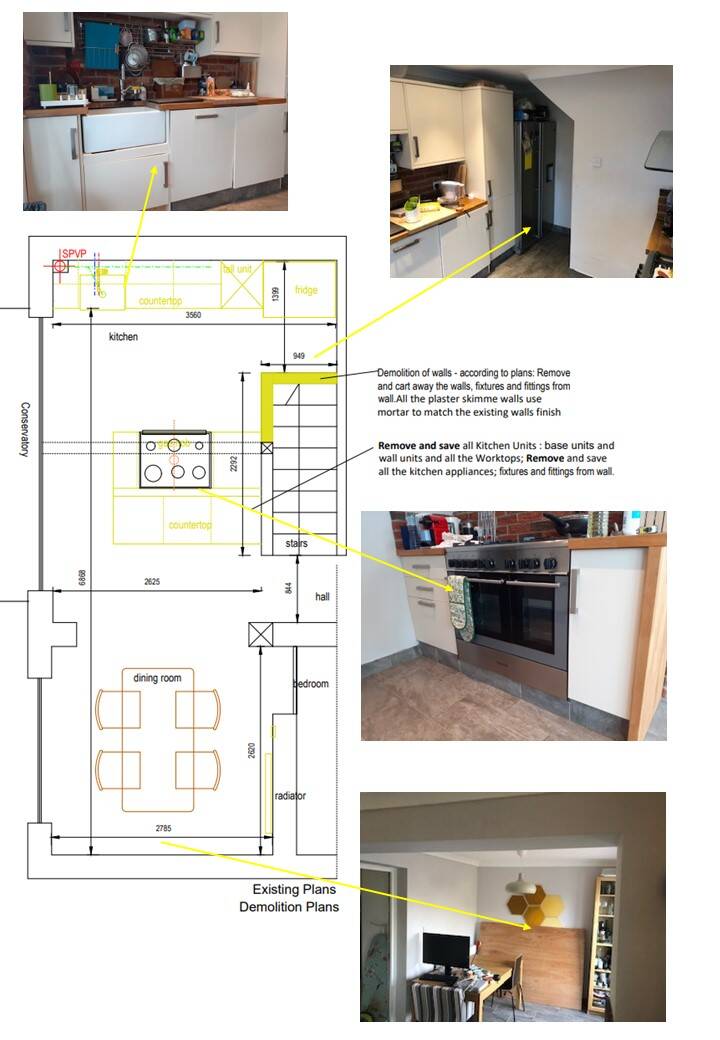
- kitchen layout was generous in size and plumbing connections easy to access. Kitchen cabinets and appliances in good conditions and possible to be reused in a new kitchen layout (input-controlled costs on extra works).
SOLUTION
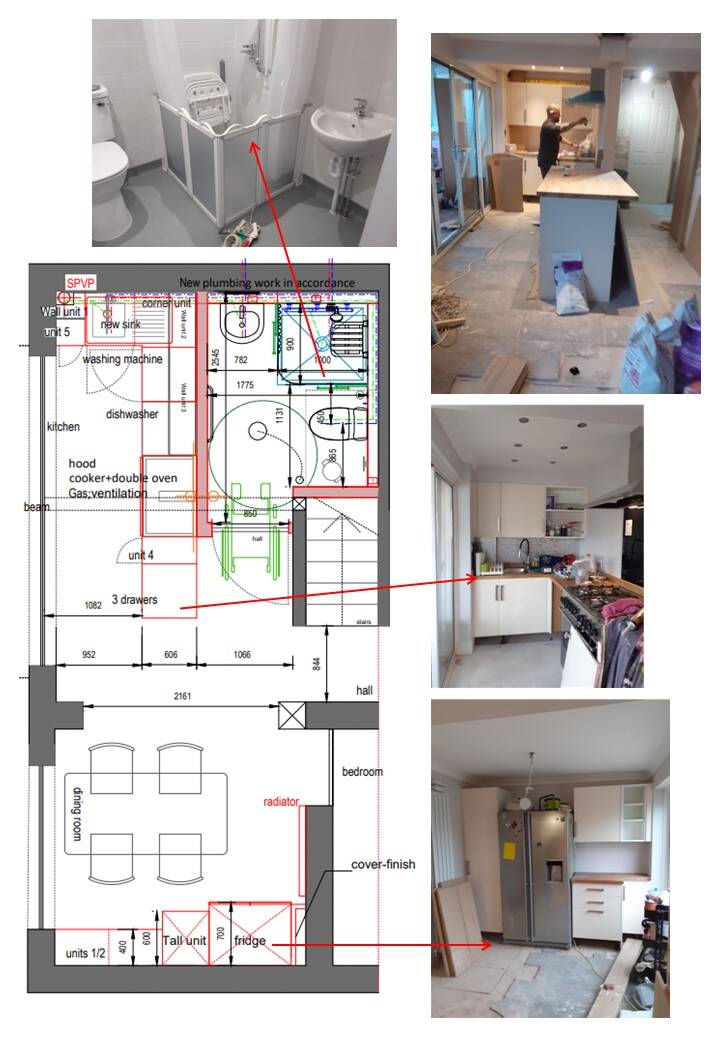
We have decided to split the kitchen into 2 spaces and deliver a kitchen with a new layout (L) and a bathroom with level access shower.
1 - Reduce kitchen area: kitchen will have a new layout. Remove and save all the Kitchen cabinets and appliances. Existing kitchen was galley and new layout proposed in L-shaped. New kitchen layout to be implemented reusing and adapting the existing kitchen cabinets and appliances. Important to know – Mrs. S don’t use the kitchen on her own.
2 –A non-load-bearing timber stud wall was built to separate the new spaces. A level-access shower and toilet were installed using part of the kitchen and space under the stairs
RESULTS AND IMPACT
Following the adaptation Mrs. S moved in with her family.
Mrs. S successfully moved in with her family, despite the added pressures of the COVID-19 pandemic. Her son is now able to provide consistent, in-person care, and she no longer lives alone.
As a wheelchair user, Mrs. S now feels safe, supported, and less vulnerable. Living with family has significantly improved her:
-
Health and wellbeing
-
Independence and privacy
-
Confidence and dignity
The new layout was designed in a logical order based on use, to support both family routines and Mrs. S’s essential needs, including easy access to a toilet and shower. This significantly improved her life quality.
LONG-TERM EFFECTS
This solution not only addressed immediate safety and accessibility needs, but also provided a sustainable, long-term living arrangement.
Thanks to the DFG, Mrs. S can continue living at home with her family, enjoying enhanced privacy, confidence, and dignity—a testament to how thoughtful adaptations can transform lives.
AUTHORED By Susana Silva BA(Hons)Arch, ARB, RIBA

CONCLUSION
This adaptation project successfully addressed three core priorities:
-
Safety throughout the home
-
Accessible bathroom and bedroom facilities
-
A redesigned ground floor kitchen with open-plan layout, allowing for a shared family dining space
The accessible design underscored the importance of flexible funding to support additional works as part of the initial adaptation. The Disabled Facilities Grant (DFG) was used rationally and responsibly, contributing to a strategic ground floor redesign that prioritised the safety and wellbeing of the disabled resident within her family home.
For both Mrs. S and her family, the additional works not only provided access to essential facilities, but also supported her ability to carry out day-to-day activities independently—with long-term benefits to her health, dignity, and quality of life.
Sustainability and Resource Efficiency
We applied the 3Rs principle—Reduce, Reuse, Recycle—throughout the adaptation:
-
Reused and recycled existing kitchen units and appliances
-
Reduced construction waste by repurposing materials on site
In collaboration with the homeowner and family, we also introduced energy efficiency upgrades, including improved radiators and lighting, with materials supplied by the client. These enhancements helped reduce energy consumption and improve overall comfort.
Collaborative Delivery During COVID-19
Despite the challenges posed by the COVID-19 pandemic, the project benefited from enhanced planning and preparation, ensuring the DFG was delivered effectively and safely.
We believe that user involvement is essential in the design and delivery of services. In this case, the family played a vital role in supporting the adaptation process, demonstrating how strong collaboration can lead to successful outcomes—even in adverse circumstances.
AUTHORED By Susana Silva BA(Hons)Arch, ARB, RIBA
Create Your Own Website With Webador