The Disabled Facilities Grant (DFG) is a statutory means-tested grant which provides funding for home adaptations making it easier for you to care for your disabled family member or increase their level of independence while in your / their home.
The Equality Act 2010 requires that Service Providers must not wait until a disabled person experiences difficulties
Service providers should make the necessary adjustment to address barriers that impede disabled people to use the building.(1)
The Historic England organization can help with the project development actions (repair and conservation or improved future management of listed buildings ); They have a number of grant schemes to help with the cost of caring for all sorts of buildings, monuments, and landscapes; Helps with the planning system to get approval over the consultation with all entities. (2)
This case study explores adaptations as a Key Part of a Wider Strategy in a Listed Building (Grade II) improving access to Historic Buildings while at the same time working within the wider principles of conservation.
A Grade II listed building is a structure that is officially recognized for its historical or architectural significance.
These buildings are protected by law and cannot be demolished, extended, or altered in any way that would affect their character without special permission from the local planning authority. However, ensuring these buildings are accessible and functional for modern use, requires creative solutions and adaptations. In this case study, we explore how adaptations to a Grade II listed building can be part of a broader strategy that balances preservation with the need for accessibility and functionality, particularly to facilitate the access to the home and garden allowing the disabled member to remain safe and independent. The challenge lies in adapting the building to meet the needs of the modern-day users without compromising its historic value.
This case study illustrates how thoughtful adaptations can successfully address the needs of individuals with life-limited prognoses in a Grade II listed building.
______________________________
(1) Equality Act 2010 legislation and Improving Access to Historic Buildings and Landscapes guidance
BACKGROUND
The Building
The case study focuses on a Grade II Manor house, originally constructed in the 19th century, 1842.
As a Grade II listed building, there are strict regulations governing any modifications. The preservation of historical features such as decorative woodwork, original fireplaces, mouldings, and staircases is a priority. The building offers historical charm, but presents a variety of challenges for use, especially when considering accessibility, mobility, and safety for vulnerable individuals.
DFG based on eligibility criteria to facilitate access to the house and garden
There is a need to remove or help overcome any obstacles which are preventing the disabled person from moving freely in and out of the property, including common parts, in and around the garden and any yard, outhouse or “other appurtenance”
(e.g. a balcony or the land adjacent to the mooring of a qualifying houseboat).
Access can also include works outside the normal curtilage of the dwelling, such as a dropped kerb pavement crossing.
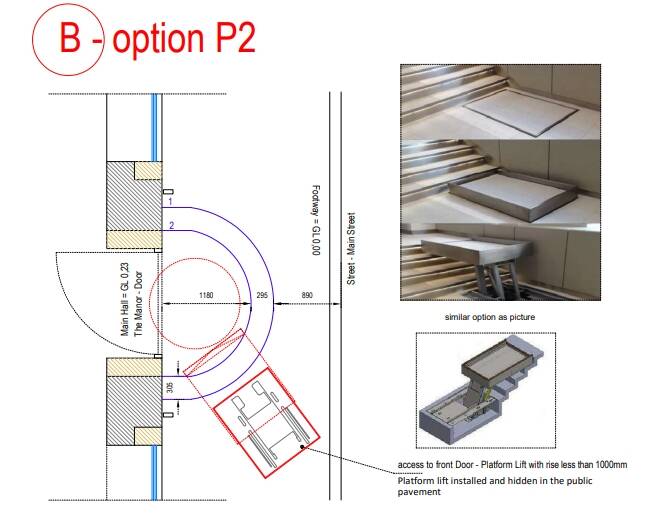
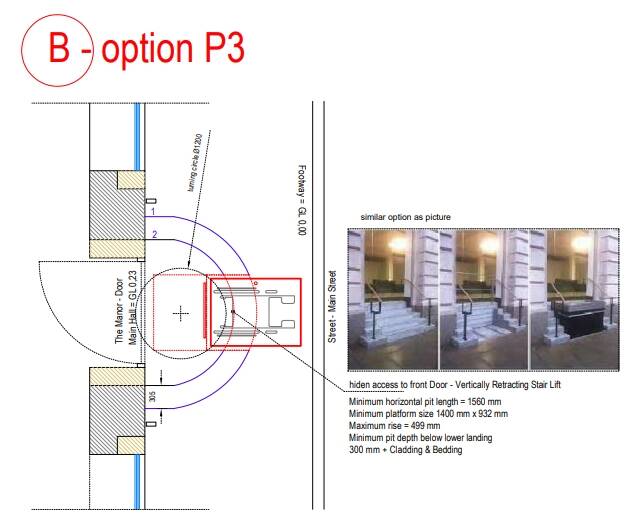
In this case a private supplier must be consulted provide front door wheelchair Permanent Solution.
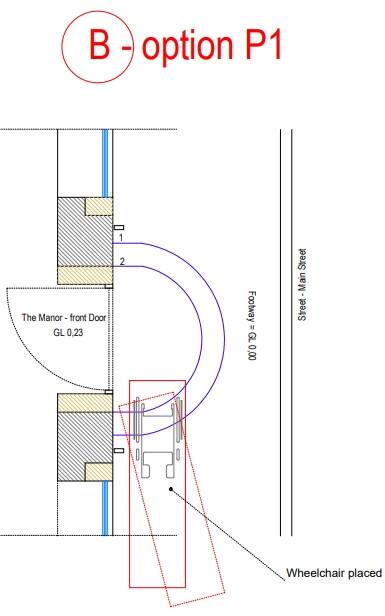
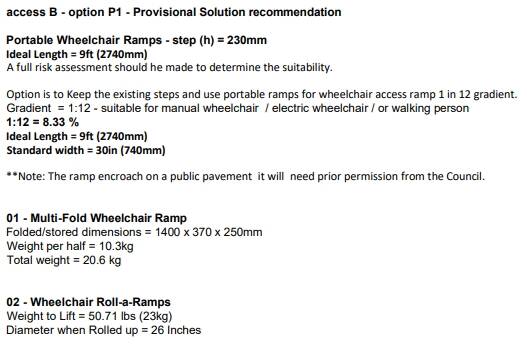
**Front door access encroaches on a public pavement and the works are to be done on the public pavement. Gov. body system (government organizations need to be consult) to final notice on planning permission application.
SOLUTION
Accessibility Modifications
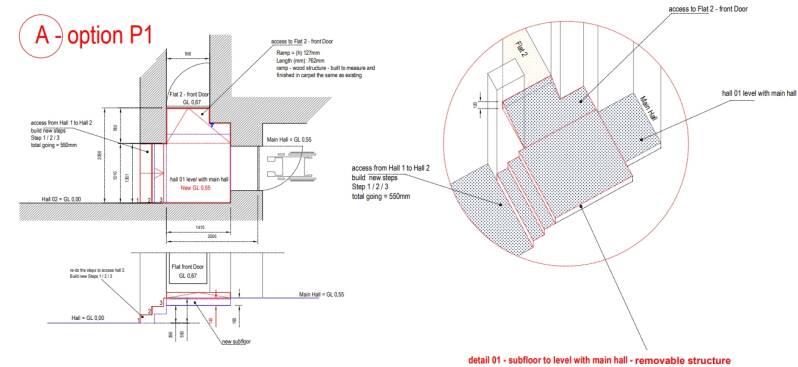
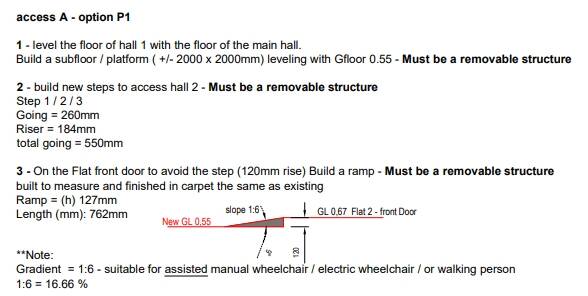
The integration of level landings , ramps ensured that common areas are accessible, making it easier for individuals with mobility impairments to navigate the building.
A) Front Door access (2 steps)
B) Main door access (3 steps)
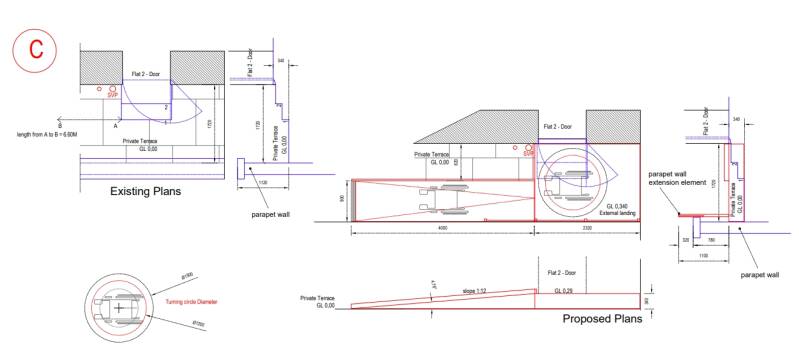
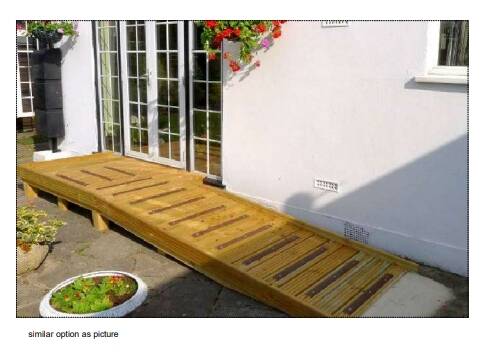
C) Terrace access (2 steps)
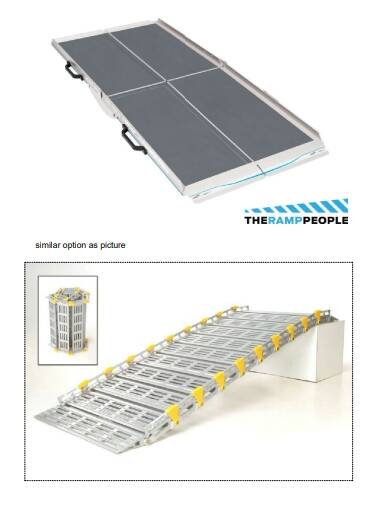
To solve accesses A; B and C we use a discreet, removable or reversible design, lightweight and non-permanent solutions that do not damage the original materials.
The wide doorways ensured the freedom to move around or receive care with dignity.
Where possible, internal floor reconfiguration was done to reduce the number of different levels , creating level floors along the way suitable for those who use wheelchairs.
To make this 19th-century building wheelchair-accessible, we carefully used non-invasive anchoring techniques to address the different levels.
We opted for reversible installations. We ensured that the solutions could be removed in the future without permanently altering or damaging the original floor structure.
We designed a modular system adjusted to subtly level the floor without eliminating the original levels and steps.
We combined materials and finishes that visually integrate with the original architecture.
Historical Preservation
The careful attention to maintaining the building’s historical integrity ensured that the Grade II listed status was preserved. The modifications to the structure were subtle and respectful, ensuring that the building continued to serve its purpose without compromising its architectural significance.
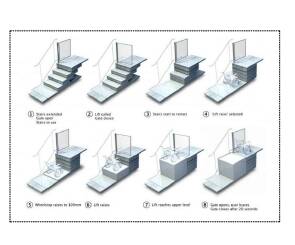
A customized "lift" was advised to provide access to front door floors of the building. Given the heritage nature of the building and the front door access encroach on a public pavement, the lift must be designed to blend seamlessly with the interior to maintain the aesthetic integrity of the original architecture. The lift's placement was also carefully considered to minimize disruption to the building's historical features and public sidewalk use by pedestrians.
CHALLENGES
Time Sensitivity - Delivering critical accessibility adaptations under the pressure of a life-limited prognosis, with the urgent goal of enabling the client to remain safe, independent, and dignified in home.
Public Interface - Designing solutions to encroach on public pavements while maintaining pedestrian usability and aesthetic harmony.
Balancing Accessibility with Conservation - Adapting a Grade II listed building to meet accessibility needs without compromising its historical integrity.
Space Constraints: Many listed buildings have narrow corridors or restricted spaces, which makes it difficult to install lifts without compromising the building’s structure or aesthetics.
Regulatory Approval: Installing lifts or ramps in a listed building often requires detailed consultation with local heritage authorities. The key challenge here is ensuring that the adaptations do not damage or detract from the building’s architectural features, such as facades, interior woodwork, or door frames.
Planning Permission: Even minor alterations, such as adding a ramp or widening a doorway, require listed building consent, which can be a lengthy and complex process.
Freeholder Responsibility - It was understood that part of the adaptation—particularly external modifications—fell under the freeholder’s responsibility. The design team submitted detailed plans and specifications, hoping the freeholder would act in accordance with the client’s needs. Under the Equality Act 2010, service providers must not wait until a disabled person experiences difficulties. Reasonable adjustments should be made proactively to remove barriers that prevent disabled individuals from accessing and using buildings.
OUTCOMES:
Project Interruption - Of the planned adaptations, only first part (A - P1) was completed. This solution provided immediate improvement in accessibility while preserving the building’s historic character. Sadly, the client passed away during the works, leading to the cessation of further modifications, including access solutions for the main door and terrace.
Time Sensitivity – This case highlighted the urgency of delivering accessibility adaptations under the pressure of a life-limited prognosis. While the design team acted swiftly to implement feasible solutions, part of the adaptation—particularly those affecting the building’s external structure—fell under the responsibility of the freeholder. The only course of action available was to submit detailed plans, specifications, and justifications, in the hope that the freeholder would act in accordance with the client’s needs.
Knowledge Contribution – Despite the incomplete execution, the project yielded valuable insights into the practical challenges and solutions of adapting Grade II listed buildings. These findings have been documented as a case study to inform future projects, particularly those focused on accessibility. Under the Equality Act 2010, service providers—including freeholders—are legally required to make reasonable adjustments to remove barriers that prevent disabled individuals from accessing and using buildings. Crucially, the law emphasizes that providers must not wait until a disabled person experiences difficulties; proactive measures should be taken to ensure equitable access.


AUTHORED By Susana Silva BA(Hons)Arch, ARB, RIBA
Create Your Own Website With Webador